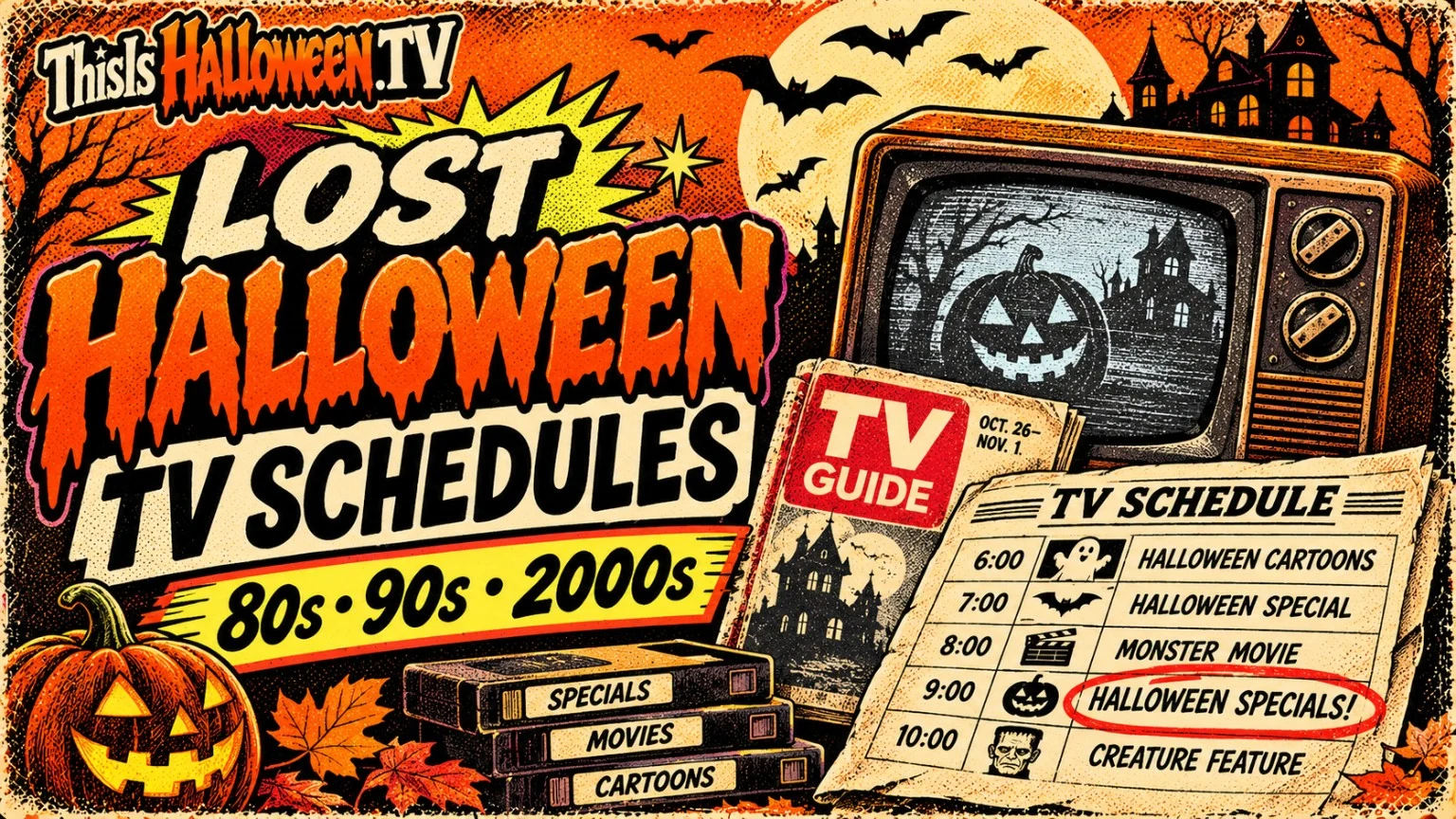
The ghosts were on the screen, the commercials were half the fun, and there was no pause button. Let's open the television listings and see what America could actually watch.
There is an irresistible version of childhood Halloween in which every network spent October 31 showing cartoons, costumed sitcoms and classic monsters. The historical listings tell a stranger—and more interesting—story. Some years, a regular sitcom shared the evening with a spooky premiere. Some years, Halloween competed with Monday Night Football. And some of the best Halloween episodes premiered before October 31, when networks expected viewers to be home rather than out trick-or-treating.
For this reconstruction, we've chosen four American prime-time schedules, each anchored to a dated listing. These are network-level examples, not a claim about everything a particular city could receive. Local affiliates, cable systems and time zones could change the lineup. That's part of the adventure: your childhood television night may have been different from the one across town.
Monday, October 31, 1988: Halloween doesn't stop ordinary television
If you turned on the major networks at 8 p.m. Eastern in 1988, you wouldn't have found a wall-to-wall horror marathon. ABC listed MacGyver, with The Secret of Parker House, before Monday Night Football. CBS carried Newhart and Coming of Age in its early evening lineup, while NBC countered with ALF and Favorite Son. Browse the dated listings.
There is a marvelous lesson in that mundane schedule. Halloween existed in the household around the television: the paper decorations, the candy waiting at the door, the rush back from trick-or-treating, and the promise that a commercial might suddenly show a haunted house or a ridiculous monster. Not every Halloween memory comes from a Halloween program. Sometimes the season lived in the interruptions.
A recreated 1988 television night could therefore pair a genuinely documented network show with period-appropriate commercial interludes and a separate, clearly labeled vintage-special selection. It shouldn't pretend that an unrelated special aired in a particular slot without evidence.
Tuesday, October 31, 1995: Roseanne and the returning Munsters
1995 gives us a more overtly haunted lineup. At 8 p.m. Eastern, ABC's schedule began with a new Roseanne episode, Halloween: The Final Chapter (season 8). The network's later listings included Home Improvement (Let Them Eat Cake), Coach and NYPD Blue. Those later episodes are worth distinguishing from the holiday-themed Roseanne: airing on Halloween isn't automatically the same thing as having a Halloween story.
Over on Fox, Here Come the Munsters premiered as a television movie on October 31. It reunited the old family's look with a new principal cast, including Edward Herrmann as Herman, Veronica Hamel as Lily and Robert Morse as Grandpa. Contemporary coverage described cameo appearances by original cast members. The Los Angeles Times preview dated October 29, 1995 corroborates the production, while the October 31 listings put it on the night itself.
CBS offered a different flavor of Gothic whimsy: its prime-time schedule included a showing of Edward Scissorhands after The Client. That gives us three quite different visions of Halloween television in the same evening: a family sitcom's elaborate holiday tradition, a resurrected monster-family television movie and a melancholy Tim Burton fantasy.
A suggested 1995-inspired watch night: Begin with Roseanne: Halloween: The Final Chapter. Follow it with your choice of Here Come the Munsters or Edward Scissorhands. Treat that as a modern recreation, not a minute-for-minute recording of a local 1995 broadcast.
Saturday, October 31, 1998: The specials were scattered across channels
Three years later, Saturday-night prime time showed how differently the networks approached Halloween. ABC's listings included Boo to You, Winnie the Pooh!, followed by regular drama programming. CBS offered Early Edition: Halloween and Walker, Texas Ranger: The Children of Halloween. Fox continued with Cops and America's Most Wanted, while NBC ran The Pretender and Profiler. The complete dated network snapshot makes a wonderful time capsule.
The contrast is the point. A family could gravitate toward Pooh, an older kid might find the Early Edition premise enticing, and an adult could leave the TV on a conventional Saturday-night crime lineup. The season wasn't always one continuous Halloween block; viewers assembled their own night by switching channels.
This is especially important for a historical project such as ours. We should describe exactly what the surviving schedule shows, then invite readers to explore other contemporary broadcasts rather than suggesting that every beloved Halloween cartoon aired on that specific date.
Tuesday, October 31, 2000: Hitchcock, Buffy and a horror movie on UPN
By Halloween 2000, the network snapshot becomes especially entertaining. Fox offered That '70s Show: Too Old to Trick or Treat, Too Young to Die, an episode built around Hitchcock-inspired suspense. The WB aired back-to-back repeats of Buffy the Vampire Slayer: Fear, Itself and Halloween. UPN's movie slot carried Stephen King's The Night Flier. See the October 31 listings.
These details are not only retrospective database entries. In a contemporary October 31, 2000 Salon column, critic Joyce Millman pointed readers to That '70s Show, the Buffy reruns and the national television coverage of New York's Greenwich Village Halloween Parade. That last item is a reminder that Halloween TV encompassed real-world spectacle as well as fictional monsters.
A modern recreation can stage this evening as a classic channel-surfing night: That '70s Show for a short, playful opening; Buffy for a familiar supernatural adventure; then an adult-only late-night option. The dated listings provide the skeleton, but our viewing suggestions are newly curated.
What about cable cartoons, local horror hosts and the commercial breaks?
A network listing is a partial record, not a full portrait of American television. Nickelodeon, Cartoon Network, Disney Channel, local stations and specialty cable channels could have shaped a child's Halloween far more than ABC's prime-time schedule. Regional commercial inserts were different, too. That is why a careful reconstruction starts with the viewer's city, not just the date.
To recreate your own Halloween night, try this research method:
- Record the date, city and cable provider if you remember them. Add your approximate viewing time.
- Consult a dated newspaper TV page or television listings archive. Keep a screenshot or citation of the listing rather than relying on a fan recollection alone.
- Separate scheduled programming from commercials captured on off-air recordings. A random ad upload may not be from the same time or market.
- Identify which programs are available from legitimate services today. Link to the right-holder or broadcaster when possible.
- Mark any gaps honestly. “A likely period-appropriate selection” is different from “aired at 8:30 p.m. in 1995.”
A Halloween night worth rebuilding
There is something more satisfying than finding one more seasonal streaming collection: discovering the texture of the holiday as people actually experienced it. In 1988, Halloween shared time with a football game. In 1995, a brand-new Roseanne episode met the returned Munsters. In 1998, spooky television was scattered through the dial. And by 2000, a viewer could choose Hitchcock jokes, two Buffy reruns or Stephen King's horror.
The television wasn't magically all Halloween. The evening was. That's the feeling we're preserving.
Keep exploring: Visit our TV Guide and Halloween Time Machine, browse the Vintage Video Archive, or learn how to stage a 1990s Halloween TV night at home.