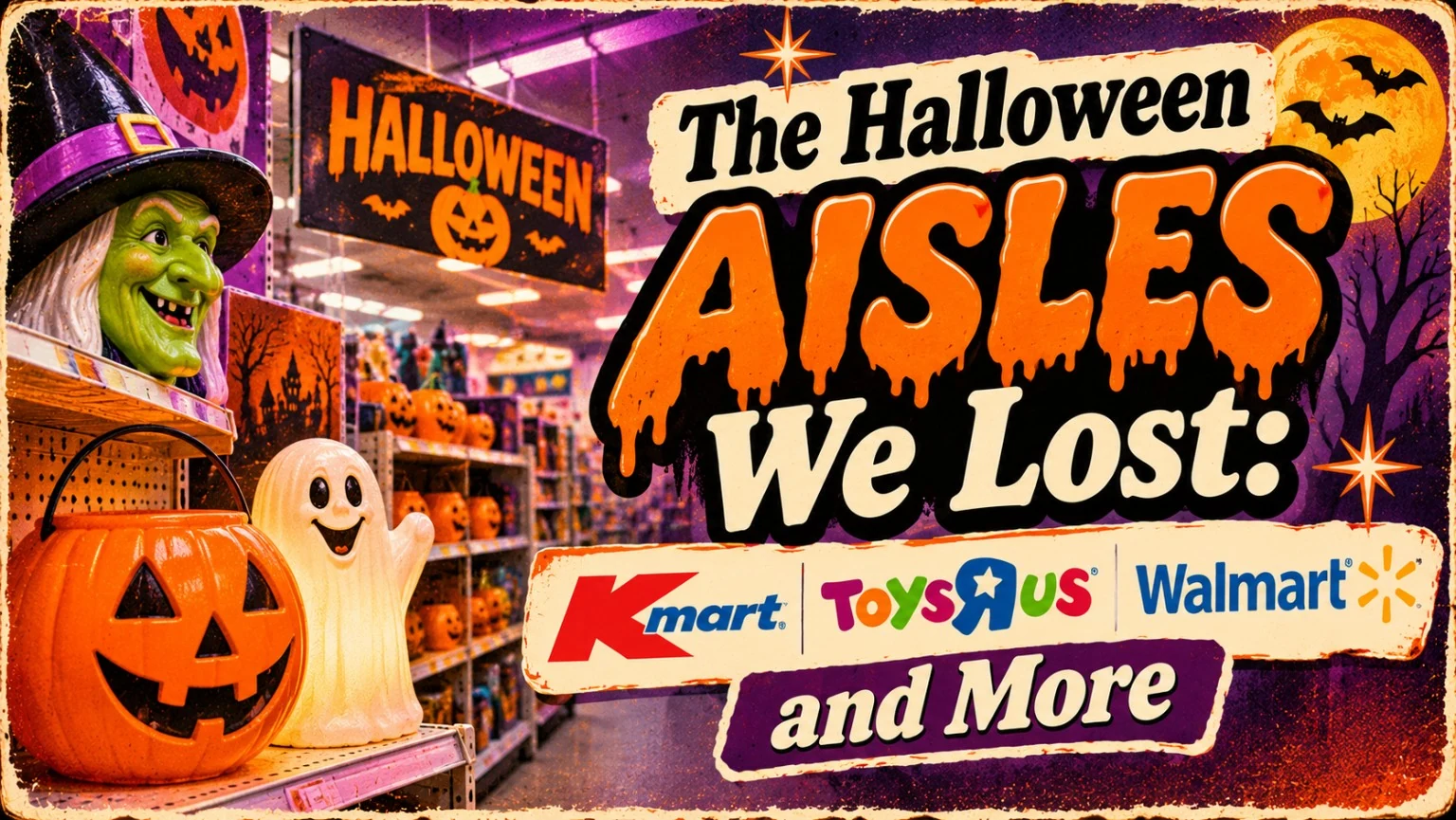
Before seasonal shopping became an endless scroll, you could tell Halloween was near because one ordinary corner of the store had gone completely, gloriously strange.
It might have started in the grocery aisle: a stack of bags printed with smiling pumpkins, candy you were forbidden to open early, or cereal boxes with monsters on the front. Then you turned the corner, and there it was: rubber masks, plastic buckets, paper skeletons, cheap makeup, a shelf of tiny flickering lights and a cassette that promised to fill your house with spooky noises.
If you grew up visiting Kmart, Toys “R” Us, Hallmark, Walmart or a local five-and-dime during the 1980s and 1990s, Halloween shopping could feel like a small amusement park. Every visit had a beginning and an end. You didn't have an infinite catalog. You had whatever was on the rack, and you could pick it up.
That memory is worth separating from myth. There wasn't one universal 1990s Halloween aisle. Stores varied by region, year and location; local newspaper ads and broadcast commercials offer stronger evidence than a modern image labeled only “retro Halloween.” Here's what surviving records tell us.
Kmart: Halloween Headquarters in a single shopping trip
A fascinating October 2, 2001 Kmart corporate announcement describes the retailer positioning itself as “Halloween Headquarters,” with costumes, accessories, decorating supplies and huge quantities of candy. The company presented the store as a one-stop alternative for families planning parties or dressing up on a budget.
That press release is an especially useful artifact because it documents the store's own seasonal merchandising strategy, not just someone's memory of a display. A typical family did not have to visit a specialty Halloween retailer to buy supplies: a discount department store wanted to cover the whole experience, from candy to the costume itself.
The wording also helps explain why Kmart looms so large in many childhood memories. The Halloween section wasn't a niche boutique. It was an island of oddness inside a place where the adults had come to buy necessities. The thrill was finding a rubber monster face next to everyday merchandise.
Toys “R” Us: the mask wall and the promise of a costume
The toy store had its own kind of magic. In a preserved Toys “R” Us Halloween commercial identified as 1985, the advertised costumes include the old-fashioned boxed-mask style associated with companies such as Ben Cooper and Collegeville. A child might not have known those company names, but the shiny mask and brightly printed costume were instantly recognizable.
Why do these packages remain so vivid? Because the design was meant to be understood in a glance. A character face was visible through a box window; a costume identity could be imagined before anyone opened it. The look belonged as much to the cardboard package as to the outfit inside.
The dated advertisement proves that such costumes were being marketed in that period; it does not establish that every Toys “R” Us sold every design or that the same display appeared throughout the country. An archive should label the specific ad rather than using it as an illustration of every store.

Hallmark Boo Bazaar: a greeting-card shop turns into a party
It is easy to forget that Hallmark was an important stop for seasonal novelties. Its late-1980s Boo Bazaar advertising promoted a playful world of masks, decorations, party accessories and goofy props. Dinosaur Dracula's archive looks back at a 1988 promotion; The A.V. Club examines a 1989 commercial that included an offer for a Spooky Sounds cassette.
The 1989 offer—$1.95 with a $5 purchase, at participating stores—reveals how a small Halloween audio purchase could be tied directly to a broader seasonal shopping trip. In other words, the retailer wasn't merely selling paper plates. It was offering costumes, jokes, soundtracks and decorations that together formed a party.
This was a different kind of October retail experience from a movie prop store. The merchandise was funny, affordable and unmistakably seasonal—just the thing you might find while shopping with a parent who had walked in for a birthday card.
Walmart: an archive built from the Sunday paper
Walmart's Halloween story is particularly visible in old newspaper advertising. A newly collected archive of Walmart Halloween print ads indexes scanned advertisements from the 1960s through the 1990s, including entries for 1988, 1990, 1991, 1992, 1993, 1994 and 1996.
These ads can help answer questions memories alone cannot: Which costumes were marketed? How were pumpkins and seasonal merchandise illustrated? Did one promotion foreground candy, decor or a specific licensed character? They also allow us to see the difference between an era's advertising layout and what an individual store might actually have stocked.
The scans should be attributed to their archivist and linked rather than silently republished as our own. Before identifying a particular item's year or price in a future article, it should be transcribed directly from that year's legible scan.
A spooky VHS rack beside the decorations
One of the strangest parts of old seasonal shopping was encountering horror movies somewhere unexpected. Dinosaur Dracula's collection of 1988 and 1990 McCrory's Halloween print advertisements documents budget horror VHS tapes as seasonal merchandise. A bargain tape display could turn a drugstore or variety store into a miniature video shop for a few weeks.
For a child, merely seeing the cover of a horror film could be the day's big scare. You didn't have to watch the movie to understand its promise; the artwork did the work. And because those racks stood among masks, candy and paper decorations, fear and fun were compressed into the same few feet of shelf space.
It's a natural overlap with our Halloween TV and vintage video collections: the store aisle, the television ad and the VHS cover often belonged to the same small world.
Spirit Halloween: the specialty-store era grows out of 1983
Today it's easy to imagine seasonal Halloween retail as a modern invention. Yet Spirit Halloween traces its roots to 1983. Its official company history confirms the starting year, while a KQED interview and origin story explains founder Joe Marver's early experiment: he saw the demand for costumes near his existing business and converted retail space to serve the Halloween season.
The rise of specialist seasonal retailers changed what shoppers could expect. Dedicated stores could give Halloween an entire interior, with props, detailed displays and inventory intended for much more than one store aisle. Yet the appeal of the older department-store corner never entirely went away. If anything, a whole storefront devoted to Halloween grew from the same sensation: stepping out of the ordinary world into October.
What made the old aisle feel different?
Part of it was the packaging. Boxed costume masks, plastic pails, cardboard cutouts and small inexpensive props were easy to display and remember. Part of it was the limited shopping experience: the choices were finite, so each object felt like a discovery. Part was simply the physical transition from school supplies or groceries into Halloween, all within a few paces.
But nostalgia can flatten the past. Some of those masks were uncomfortable. The costumes could be fragile, the selection limited and the decorations flimsy. These were not necessarily superior products. They were memorable experiences—and the most useful historical articles explain both.
How to build a real archive of Halloween retail
If you still have a picture of your local Halloween aisle, it is a genuine piece of seasonal history. Note the store, city, approximate month/year and what is visible. If you can, pair it with an advertisement or catalog from the same period. Share photographs only with the owner's permission, and distinguish the photographed item from an advertising image.
An excellent future collection could organize surviving ads and photos by retailer and decade: Kmart, Toys “R” Us, Hallmark, Walmart, McCrory's and regional variety stores. It would also preserve the increasingly hard-to-find local stores, because they may be the most personal memories of all.
We may never walk through the exact Halloween aisle we remember again. But with dated circulars, television spots and a little care, we can recover what was on the shelves—and why wandering through them mattered so much.
Keep exploring: Browse our Halloween website directory, revisit 50 vintage Halloween commercials and TV promos, and discover DIY vintage Halloween decorations.