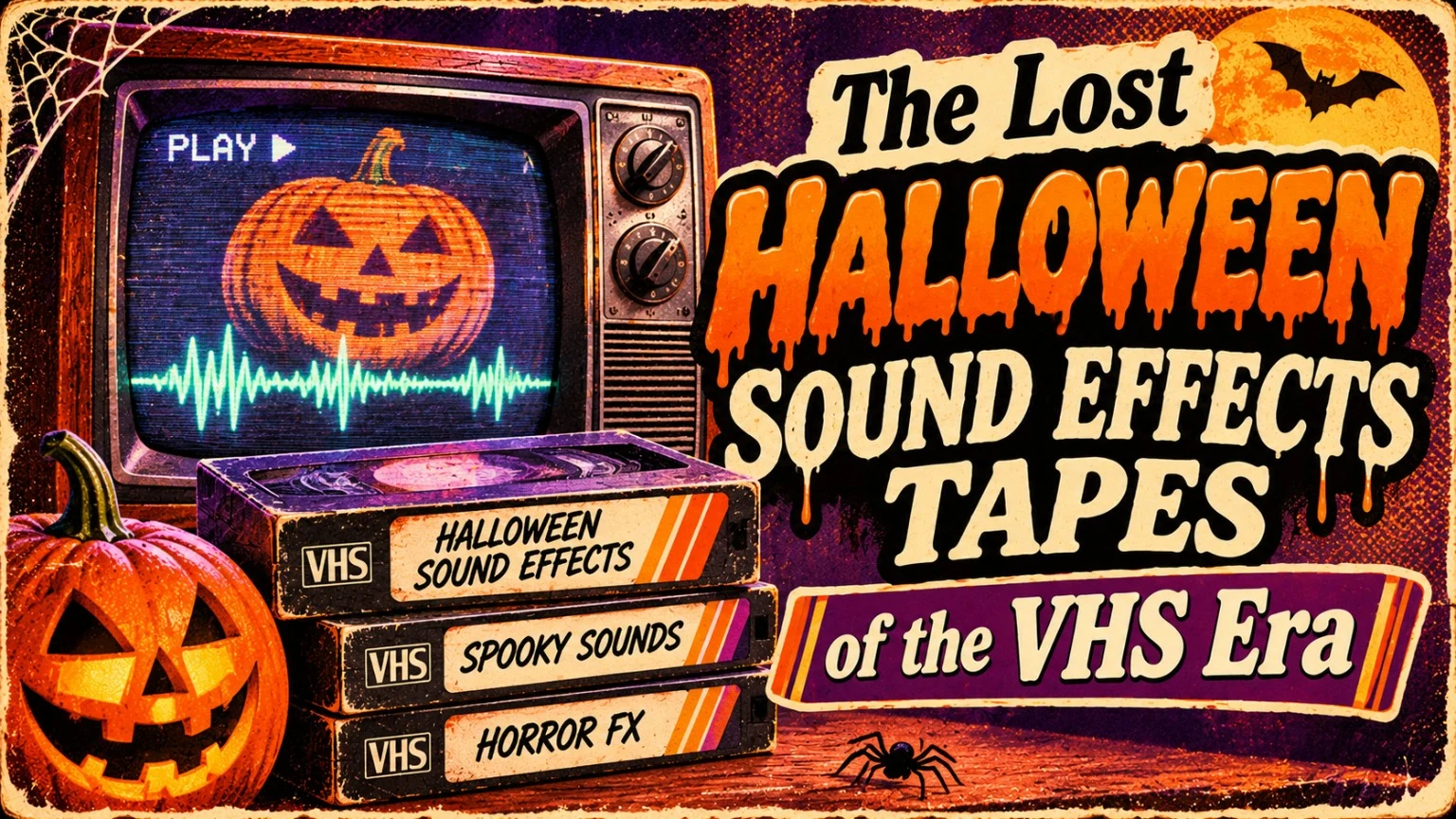
Before a smart speaker could conjure a haunted mansion, somebody had to put on a record, turn over a cassette—or hide a boombox behind the hedge.
In the old Halloween soundscape, a ghost was often a recording. Thunder growled from a living-room speaker. A floorboard creaked in a rhythm that nobody recognized until the next October. A wolf howled from a tape near the front door, and every so often a scream emerged so suddenly that the trick-or-treaters jumped.
These sounds came from an overlooked category of Halloween ephemera: sound-effects LPs, party records, cassettes and albums designed less for close listening than for transforming an ordinary house. The records also preserve a fascinating transition—from spooky narration to practical sound libraries to inexpensive seasonal audiotapes.
Disney's haunted house in a record sleeve: 1964
One of the most recognizable records in this tradition is Disneyland Records' Chilling, Thrilling Sounds of the Haunted House, catalog number DQ-1257, issued in 1964. Collector documentation identifies Laura Olsher as narrator and describes its structure: narrated, atmospheric stories on one side; standalone sound effects on the other. Its later reissues appeared with several cover variations, including a 1973 sleeve advertising party hints. View the discography entry.
That two-sided design says something important about how families used the record. Side one could turn a room into a tiny theater, with narration prompting the listener to imagine whatever wasn't visible. Side two was a utility: isolate the creaking doors, thunder or haunting cries, and you could supply a soundtrack to the front porch or homemade haunted house.
Do not confuse the original 1964 record with other Disney haunted-house releases or later reissues bearing similar titles. Catalog number, label artwork, sleeve variant and region can help collectors identify the exact edition.
The BBC's surprisingly extreme sound laboratory: 1977
Across the Atlantic, the BBC issued BBC Sound Effects Vol. 13: Death & Horror. The label's surviving paperwork lists March 1977 as its release date. The choice of number 13 was deliciously on-theme, but the record was not a cute children's sing-along. Its sounds belonged to the world of radio drama, cinematic violence and make-believe catastrophe.
A detailed BBC Records historical article explains how the record grew out of an extensive sound-effects catalog used by broadcasters. An archival follow-up examining production documents establishes the planned March 1977 issue and even discusses rights-clearance concerns surrounding one sound's title. That is an unexpectedly relevant lesson for modern archive builders: preserving a recording is not the same as inheriting permission to republish it.
The appeal of Death & Horror was that it sounded like somebody had opened a door that should have stayed locked. A domestic turntable, ordinarily devoted to music, suddenly became a source of cinematic dread.
The cheap, wonderful Pickwick party records
Not every Halloween sound record had Disney branding or broadcaster pedigree. Discount-label party LPs brought monsters to homes without a large budget. A collector's record inventory identifies Sounds of Terror (Pickwick, 1974) and another Pickwick record called Sounds to Make You Shiver, for which the page does not establish a release date.
These titles are easy to misidentify. Several records over the decades reused nearly interchangeable phrases like “Sounds of Terror,” “Haunted House” and “Sounds to Make You Shiver.” For a serious collection, preserve the label, catalog number, sleeve image and track list, whenever independently documented. The cover art is often part of the nostalgia, but the recording's ownership remains separate from the physical record.
A scratchy record wasn't a technical failure in a Halloween setting. The surface noise could make the atmosphere feel as though something were rustling in another room.
A Halloween cassette at the Hallmark checkout
By the late 1980s, a Halloween soundtrack could be an impulse buy at a familiar retail store. In a 1989 Hallmark Halloween commercial, customers were offered a Spooky Sounds cassette for $1.95 with a $5 purchase at participating stores, according to The A.V. Club's examination of the period TV spot.
It's a small detail that opens a window onto how October shopping once worked. Halloween sound didn't live only in record stores. It was part of a seasonal display alongside inexpensive costumes, joke props, decorations and classroom-friendly novelties. A cassette fit into the family car, an ordinary tape deck or a portable player hidden in the bushes. No special installation was required.
The cassette also had an almost magical ability to loop an atmosphere without drawing attention to itself. When the tape clicked off, someone had to turn it over—or rewind the whole room's haunted soundtrack.
What exactly were people buying?
There were several overlapping categories that a vintage Halloween audio archive should preserve separately:
- Narrated horror soundscapes: Guided ghost stories and cinematic sequences for people who wanted to listen.
- Practical sound-effects libraries: Individual doors, storms, screams and footsteps for parties, home movies and stage productions.
- Musical Halloween party albums: Songs, novelty tracks and spooky instrumentals that could play while guests mingled.
- Promotional retail tapes: Low-cost seasonal cassettes, sometimes connected to a store advertisement.
- Local recordings: Homemade mixes of sound effects and music, often impossible to date without the original owner's notes.
The Library of Congress Halloween audio guide offers a broader view of supernatural sound traditions and recorded music, from ghost-story songs to early commercial recordings. Those materials remind us that Halloween audio history extends far beyond the 1970s and 1980s retail boom.
Recreating the old haunted porch today
You can revive the atmosphere without copying anyone's protected album. Use a rights-cleared or self-recorded collection of wind, footsteps, distant thunder and door creaks. Play it at a considerate volume, keep equipment dry and electrically safe, and avoid sound effects that could be mistaken for a real emergency. For very young trick-or-treaters, an occasional owl or friendly ghost is often more welcoming than a relentless scream.
A particularly convincing progression is to begin with light wind and distant ambience before a subtle knock or floorboard creak. The important thing isn't loudness; it is the idea that something might be just beyond the porch light.
How to research a recording before adding it to an archive
First identify the original issue, not a recent video upload. Check discography information, title, record label, catalog number, year and whether the edition has the same track listing. Link to the owner or archival catalog when possible. If an uploader has placed an old LP on a video service, that upload is not by itself proof that the album is free to reproduce or embed elsewhere.
The haunting sound you remember may have come from a Disney LP, a BBC studio effects record, a Pickwick party album, a Hallmark cassette—or somebody's entirely homemade mix. The sound of Halloween wasn't one song. It was a whole strange medium, passed from one generation of inexpensive speakers to the next.
Keep exploring: Browse the Halloween Video & Audio collections, find our vintage commercials archive, and see the ads that sold Halloween as an experience.